Top 10 Games I Played in 2025
All things considered, 2025 was not a bad year. Finally, after two years of dealing with a problematic project, my team and I have completed it with notable success. That alone would have made the whole year a success in my eyes, but only because I managed to maintain a relatively healthy, if imperfect, mental and physical well-being. I even bought a car to replace the one I totaled in 2024.
In line with my improved health and mood, I managed to play more games this year than average, although I must confess that the overall quality of those games was a bit lacking compared to the last three or so years. As such, it was a bit difficult to come up with a list of the Top 10 Games I Played this year, but I can still vouch for these 10 games.
As usual, my end-of-year selection straddles genres, consoles, and even generations with two PS1 games on the list. Notably, the list is more balanced this year in terms of genres, with no single genre taking more than two spots, and without the usual domination of JRPGs and TRPGs in my lists. This makes me keep faith with my curated play queue, and excited for what’s in store for me in the future. Without further ado, here is my top 10 list of games I played in 2025, ordered alphabetically:-
Astalon: Tears of the Earth (2021, NS/MP):

Metroidvanias may be the most crowded genre in the already crowded indie gaming space, and as such, any game competing in the space needs to have something special to be noticed and remembered. Fortunately, Astalon: Tears of the Earth has such a special ingredient, even if the masses didn’t pick up on it and the game failed to make much of a splash.
Beyond its retro-inspired design and joint three playable characters, the major innovation of Astalon involves a pact with the Titan of Death, which allows the heroes to resurrect every time they die. In practical terms, this means that each time you die, you repeat this Metroidvania from the beginning, which you can imagine being a slog, but it is far from it. As you progress through the game, you unlock knowledge of the castle’s map, as well as reveal permanent shortcuts. Also, whenever you die, you can spend the souls you harvest from enemies to power up and gain extra abilities.
This constant loop of exploration and death propels the game forward thanks to a fast and satisfying action-platforming gameplay that successfully pulls you back in. It also provides an extra incentive to keep your wits about you and avoid death at all costs. Yet, what proves the game’s special appeal to me is that I was always ready to jump back into the castle after every death with no hesitation.
Hyrule Warriors: Age of Calamity (2020, NS):

Koei Tecmo’s Muso (Warriors in the West) franchise was infamous for its repetitive gameplay and recycled elements across both mainline Dynasty Warriors and Samurai Warriors series, which was a bit unfair for fans of those games, considering the mechanical improvements each iteration boasted. However, the Muso name arguably only shook that negative reputation with the release of the first Hyrule Warriors game on the Wii U, which was an unlikely yet brilliant mash-up of the two franchises. After many other similar mash-ups of known franchises with Muso style, it became clear that Koei Tecmo and Omega Force were at their best in these spin-off games.
However, being spin-off games, the story of a lot of them was often an afterthought. For example, the first Hyrule Warriors games mashed up several Legend of Zelda games and characters in a dimension/time-mashing story that made little sense. That’s what made Age of Calamity a different prospect from the start. Not only does it explore the canon of the Breath of the Wild continuity, but it also exclusively utilizes that game’s style.
With its style and story firmly rooted in a single game, Age of Calamity delivers something special on its own right. With excellent art direction and musical choices, the game is brimming with personality both in its level and character designs.
Yet, it’s not for the story (which is passable at best) or even the great art direction that you will enjoy this game, but for the excellent gameplay. It is frankly surprising how damn unique each character in the game is to play. From Revali’s airborne-focused technique to Urbosa’s timing-based charge attacks, it feels different with each character you use, and all of them are so fun to play as. This resulted in me just spending so much time with each character just to play the game, not really caring what the next level offers, and that’s the highest praise you can give to any Hack n’ Slash game.
Lunar 2: Eternal Blue Complete (1999/2000/2025, PS1/NS/MP):

The Game Arts development studio is known by JRPG fans as one of the first studios that seriously tried to make an Anime-like JRPG. That didn’t only mean a JRPG with design based on Anime, but one also with a sense of romance, character, and adventure that felt absent from the fantasy-focused games of the time. You can see that style in the first Lunar game and the Grandia franchise, which I wrote about in this blog last year. Naturally, then, it is this same style and spirit that makes Lunar 2: Eternal Blue Complete one of the best games I played this year.
While the first Lunar game established the hallmarks of Game Arts storytelling and game design, it was the second game that tweaked things enough to become a great instead of a merely good game. The story of Lucia’s descent into the world of Lunar and her subsequent character growth and romantic adventure with Hiro is as memorable now as it was over 20 years ago. Which is why I wholeheartedly recommend the Remastered edition for fans of JRPGs who want to experience the reason the genre continues to persevere and inspire today.
Paper Mario: The Origami King (2020, NS):

It frustrates me to no end that the discourse about every new Paper Mario game focuses on the differences from the first two Paper Mario games rather than the merits of the new one. At this stage, there are more games in the franchise NOT in the style of the first two, so it shouldn’t be expected at all. In effect, the last three games in the series (including this one) are more action-adventure games than RPGs.
It is doubly frustrating because it distracts from the positives of games like Color Splash, and frankly, the brilliance of The Origami King. Yes, this game is unquestionably brilliant. It has some of the best storylines of any Mario RPG, it is filled to the brim with comical and smart writing, and it looks and sounds absolutely gorgeous. Other than its admittedly divisive battle system, it fires from all cylinders.
Yet, even the controversial battle system has its merits. While it is true that the lack of RPG growth mechanics can dilute the reward of battles, that shouldn’t matter if you enjoy the battle system as much as I did. To be clear, the “battle” system is not typical of any RPGs, but is rather a self-contained, rapid puzzle-solving exercise, which should be fun for fans of puzzlers.
Regardless of your mileage with the battle system, and I completely accept that many people wouldn’t like it as much as I did, I cannot accept the blindness in recognizing the amount of charm and craft in this game, which establishes it as one of the best Paper Mario games.
Resident Evil Village (2021, PS4/PS5/MP):

If we consider Resident Evil 7 to be an attempt at recreating the Resident Evil formula in first-person, then Resident Evil Village is the attempt at recreating the phenomenal Resident Evil 4 in first-person, and it mostly succeeds.
After the events of the last game, Ethan Winters is obviously more experienced in surviving the horrors of the RE world, and that is reflected in the more action-packed gameplay of this game. While not as competent as Chris Redfield’s DLC segment in Resident Evil 7, Ethan is now able to move faster and deal with more enemies than he ever could.
Thankfully, the game doesn’t forget its survival roots, and like Resident Evil 4, I feel that it strikes a good balance between action, survival, and horror. Unfortunately, the game repeats the mistake of its predecessor of having the highlight of the game at the beginning and ending with less inspired locations. Yet, at no point does the game become boring, and it was honestly fun from start to finish.
Super Mario 3D All-Stars (2020, NS):

It's probably not fair to sing the praises of a game collection that is no longer available, but that's, of course, going to be the case when I just played some of the greatest 3D Platformers of all time.
Super Mario 64 surprised the most with its retained brilliance. Its sense of movement and exploration is still as strong today as it was nearly 30 years ago, and that's simply unparalleled in any game outside of Super Mario. Besides the healthy dose of nostalgia, I enjoyed every minute in that game.
On the other hand, this was the first time I played Super Mario Sunshine, which is widely considered to be the weakest 3D Mario game. Still, despite my agreeing with that sentiment, it is a great game with the same brilliance in movement and inventiveness in level design.
Yet, for the greatest inventiveness, we must look at the brilliant Super Mario Galaxy on the Wii, which should be played with dual Joy-Cons for the best control. I loved the original on the Wii, and playing it again, its brilliance shines obviously once more. Playing it on a bigger screen, I am in awe of the brilliant vistas and background space scenes as well.
Overall, this is an imperfect collection (thanks to not being widely available and missing Super Mario Galaxy 2), but is still a collection of THREE brilliant games, and that's the undeniable bit.
Tales of Arise (2021, PS4/PS5/MP):

I always considered the "Tales of" JRPGs to be a solid palate cleanser, games that I know I am going to enjoy, but maybe forget and blend them together in my mind. Tales of Arise bucks that trend, as it is easily one of the best games in that franchise, and one that pushes the boundaries of the series.
While I miss some of the charm of the 2D art in skits, and some of the cheesy shenanigans the series is known for, I begrudgingly accept that trade for the deeper story and brilliant art direction of this iteration. With its excellent Action RPG combat, brilliant characterization, and a well-written story about the nature of oppression and prejudice. Even the composer, Motoi Sakuraba, seems to be energized by the new direction of the series, with some of his best music in a Tales game.
In conclusion, this is not only Tales at its best, but a great Action-RPG on its own right. A game that I wanted to play and enjoyed playing from start to finish, which is not something I say often with this franchise.
Tunic (2022, NS/MP):

It isn't often that you find a game that can oscillate from being modestly good to brilliant as quickly as Tunic. Ostensibly an isometric action-adventure game, Tunic is a fun game that doesn't push the boundaries of the genre in any meaningful way. At least not if you were playing it with a guide. Playing the game with any outside help wouldn't give it justice at all. Instead, you must engage with its own opaque information system.
At its base, everything you need to finish the game is available to you from the start. However, everything is presented in a language you can't understand, and you gain information by finding pages of the game's instruction manual. After finding these pages, you must try to decipher them to understand where to go and what to do. This leads to three ways in which you can play the game:
One, you can try and brute force your way through the game's world, figuring out things by trial and error and engaging in a limited way with the game's manual and the world's puzzles. I don't think you can ever get the true ending through this method.
Two, you can try to understand some of the logic behind the game, and you will probably be able to not only figure out things more easily, but also collect all the "secret fairies" and get the true ending.
Third, you can try to actually figure out the game's language itself and be able to translate every word in the manual if you want, and that joy was the greatest gift the game gave to me.
Throughout the game, solving the puzzles felt earned in a way that is rare in similar games, and I felt engaged throughout my experience with it. At first, I didn't think I was going to try to decipher the language, but I am damn glad that I did.

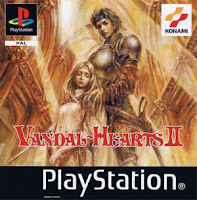
While the first Vandal Hearts game was Konami's attempt at making a traditional Tactical RPG, its sequel was in many ways a complete revolution of the genre. Through its innovative "Dual-Turn" System and abandonment of fixed classes, it went out of the comfort zone of the first game.
These changes could have failed, and indeed, the new gameplay system needs some getting used to. However, thanks to a brilliant story that followed Konami's attempts at more "mature" storylines in the PS1 era, the game ended up being one of the finest Tactical RPGs on the system.
There was little reason for Konami to revolutionize the TRPG genre with this game. It would have been perfectly acceptable to iterate on the first game, especially with how good the story is. Instead, the game took a big risk with its new gameplay style; a risk that I can imagine some did not understand or appreciate. For me, once I figured out that the "Dual-Turn" system was basically a massive programming logic puzzle, it made every battle such a brilliant strategic puzzle. One that is entirely unique within the genre, making a game that has both a great story and great gameplay.
Yakuza: Like a Dragon (2020/2021, PS4/PS5/MP):

Even with a story that came to a typical Yakuza melodramatic end, as those stories go, this one is probably one of the best in the Yakuza series. Without having to deal with much of the baggage that Kazuma Kiryu carried across the years, new protagonist Ichiban Kasuga finishes his first story with effective aplomb. Typically, I roll my eyes at the convenience and coincidences of much of these plots, and that certainly is the case here, but I think the melodrama managed not to go overboard this time because the story didn't have to deal with the entire history of the franchise this time.
A fresh start was what the series needed, and that was mostly apparent with the controversial change to the gameplay. Simply, the turn-based RPG gameplay is brilliant and one of the best parts of the game. Inspired by Dragon Quest, this is the "mature" JRPG that many people were clamoring for, and its snappy combat is approachable across most of the game (except for two noticeable difficulty spikes).
Outside of the main story, there is the usual abundance of side stories and side activities that the series is known for. Many of those are back from earlier games, but I still can waste hours a time playing mahjong or shogi. The sub-stories are not the best in the series, but they are alright.
Card Shark (2022, NS/MP):

Maybe I got more enjoyment from this game as an avid card player, but my guess is simply that it is a unique gym in a crowded space. This is simply a narrative-heavy game about a couple of cheats in pre-revolutionary France. The main gameplay mechanic is learning a series of classic card cheats and utilizing them to win money from unsuspecting stooges. None of the tricks are complicated from a gameplay perspective, and there could be an argument that there is a very limited approach to each encounter, but cheating techniques start building on top of each other satisfyingly, and the style of the game kept me engaged.
There is an unrealized brilliant game here where you have more freedom in how to tackle each con. Also, the fact that you are only cheating and not playing cards does not show how your moves would impact a real full game of cards. A better game than Card Shark would have included a full card-playing mechanic. Yet, what we have here is still very good, and that's due to both its unique gameplay hook and brilliant aesthetics.
Civilization V (2010, PC):

This is not the first time that I put Civilization V in one of these lists, and I am afraid it may not be the last. Last year, I inexplicably felt a strong urge to play the game, and for a month, all I could think of was my next turn in the game. Even during my sleep, I was dreaming about optimization strategies for my next run.
Then, about 60 hours of game time later, just as suddenly as the urge came to me, it disappeared. After conquering the world as The Huns, I dropped the game once again, but I know that the siren call of “One More Turn” will reach me again in the future.
Lost Judgment (2021, PS4/PS5/MP):

The “Judgment” franchise is a spin-off of the “Yakuza” franchise, which appears to retain the brawler gameplay of the originals as the franchise transitions into JRPGs. As such, the gameplay in Lost Judgment is similar in form and structure to earlier Yakuza games in many ways, with the symbolic additions of some “detective” tools and twists.
In the second game of the franchise, the detective Yagami finds himself embroiled in murder cases related to damaging bullying incidents in Japanese high schools, and from this premise, two games develop that are tonally clashing. First, there is the main murder case and the serious ramifications of bullying, and then that develops into a grand conspiracy that frankly loses the moral thread and buries itself in its own gibberish. Second, there are the lighthearted school drama stories that Yagami finds himself roped into, and these harken back to the wacky side stories of the franchise, with its funny and endearing cast of characters, as well as a host of mini-games to experience. Overall, I think the formula with all of its strengths and weaknesses is already established, and Lost Judgment won’t change your mind.
The Wonderful 101 Remastered (2020, NS/MP):

In line with my improved health and mood, I managed to play more games this year than average, although I must confess that the overall quality of those games was a bit lacking compared to the last three or so years. As such, it was a bit difficult to come up with a list of the Top 10 Games I Played this year, but I can still vouch for these 10 games.
As usual, my end-of-year selection straddles genres, consoles, and even generations with two PS1 games on the list. Notably, the list is more balanced this year in terms of genres, with no single genre taking more than two spots, and without the usual domination of JRPGs and TRPGs in my lists. This makes me keep faith with my curated play queue, and excited for what’s in store for me in the future. Without further ado, here is my top 10 list of games I played in 2025, ordered alphabetically:-
Astalon: Tears of the Earth (2021, NS/MP):
- Genre: Metroidvania.
- Developer: LABS Works.
- Publisher: DANGEN Entertainment.
Metroidvanias may be the most crowded genre in the already crowded indie gaming space, and as such, any game competing in the space needs to have something special to be noticed and remembered. Fortunately, Astalon: Tears of the Earth has such a special ingredient, even if the masses didn’t pick up on it and the game failed to make much of a splash.
Beyond its retro-inspired design and joint three playable characters, the major innovation of Astalon involves a pact with the Titan of Death, which allows the heroes to resurrect every time they die. In practical terms, this means that each time you die, you repeat this Metroidvania from the beginning, which you can imagine being a slog, but it is far from it. As you progress through the game, you unlock knowledge of the castle’s map, as well as reveal permanent shortcuts. Also, whenever you die, you can spend the souls you harvest from enemies to power up and gain extra abilities.
This constant loop of exploration and death propels the game forward thanks to a fast and satisfying action-platforming gameplay that successfully pulls you back in. It also provides an extra incentive to keep your wits about you and avoid death at all costs. Yet, what proves the game’s special appeal to me is that I was always ready to jump back into the castle after every death with no hesitation.
Hyrule Warriors: Age of Calamity (2020, NS):
- Genre: Muso Hack n’ Slash.
- Developer: Omega Force/ Koei Tecmo.
- Publisher: Nintendo.
Koei Tecmo’s Muso (Warriors in the West) franchise was infamous for its repetitive gameplay and recycled elements across both mainline Dynasty Warriors and Samurai Warriors series, which was a bit unfair for fans of those games, considering the mechanical improvements each iteration boasted. However, the Muso name arguably only shook that negative reputation with the release of the first Hyrule Warriors game on the Wii U, which was an unlikely yet brilliant mash-up of the two franchises. After many other similar mash-ups of known franchises with Muso style, it became clear that Koei Tecmo and Omega Force were at their best in these spin-off games.
However, being spin-off games, the story of a lot of them was often an afterthought. For example, the first Hyrule Warriors games mashed up several Legend of Zelda games and characters in a dimension/time-mashing story that made little sense. That’s what made Age of Calamity a different prospect from the start. Not only does it explore the canon of the Breath of the Wild continuity, but it also exclusively utilizes that game’s style.
With its style and story firmly rooted in a single game, Age of Calamity delivers something special on its own right. With excellent art direction and musical choices, the game is brimming with personality both in its level and character designs.
Yet, it’s not for the story (which is passable at best) or even the great art direction that you will enjoy this game, but for the excellent gameplay. It is frankly surprising how damn unique each character in the game is to play. From Revali’s airborne-focused technique to Urbosa’s timing-based charge attacks, it feels different with each character you use, and all of them are so fun to play as. This resulted in me just spending so much time with each character just to play the game, not really caring what the next level offers, and that’s the highest praise you can give to any Hack n’ Slash game.
Lunar 2: Eternal Blue Complete (1999/2000/2025, PS1/NS/MP):
- Genre: JRPG.
- Developer: Game Arts/Ashibi Co. (Remastered)
- Publisher: Kadokawa Shoten/Working Designs/GungHo (Remastered)
The Game Arts development studio is known by JRPG fans as one of the first studios that seriously tried to make an Anime-like JRPG. That didn’t only mean a JRPG with design based on Anime, but one also with a sense of romance, character, and adventure that felt absent from the fantasy-focused games of the time. You can see that style in the first Lunar game and the Grandia franchise, which I wrote about in this blog last year. Naturally, then, it is this same style and spirit that makes Lunar 2: Eternal Blue Complete one of the best games I played this year.
While the first Lunar game established the hallmarks of Game Arts storytelling and game design, it was the second game that tweaked things enough to become a great instead of a merely good game. The story of Lucia’s descent into the world of Lunar and her subsequent character growth and romantic adventure with Hiro is as memorable now as it was over 20 years ago. Which is why I wholeheartedly recommend the Remastered edition for fans of JRPGs who want to experience the reason the genre continues to persevere and inspire today.
Paper Mario: The Origami King (2020, NS):
- Genre: Action-Adventure.
- Developer: Intelligent Systems.
- Publisher: Nintendo.
It frustrates me to no end that the discourse about every new Paper Mario game focuses on the differences from the first two Paper Mario games rather than the merits of the new one. At this stage, there are more games in the franchise NOT in the style of the first two, so it shouldn’t be expected at all. In effect, the last three games in the series (including this one) are more action-adventure games than RPGs.
It is doubly frustrating because it distracts from the positives of games like Color Splash, and frankly, the brilliance of The Origami King. Yes, this game is unquestionably brilliant. It has some of the best storylines of any Mario RPG, it is filled to the brim with comical and smart writing, and it looks and sounds absolutely gorgeous. Other than its admittedly divisive battle system, it fires from all cylinders.
Yet, even the controversial battle system has its merits. While it is true that the lack of RPG growth mechanics can dilute the reward of battles, that shouldn’t matter if you enjoy the battle system as much as I did. To be clear, the “battle” system is not typical of any RPGs, but is rather a self-contained, rapid puzzle-solving exercise, which should be fun for fans of puzzlers.
Regardless of your mileage with the battle system, and I completely accept that many people wouldn’t like it as much as I did, I cannot accept the blindness in recognizing the amount of charm and craft in this game, which establishes it as one of the best Paper Mario games.
Resident Evil Village (2021, PS4/PS5/MP):
- Genre: Survival-Horror.
- Developer: Capcom.
- Publisher: Capcom.
If we consider Resident Evil 7 to be an attempt at recreating the Resident Evil formula in first-person, then Resident Evil Village is the attempt at recreating the phenomenal Resident Evil 4 in first-person, and it mostly succeeds.
After the events of the last game, Ethan Winters is obviously more experienced in surviving the horrors of the RE world, and that is reflected in the more action-packed gameplay of this game. While not as competent as Chris Redfield’s DLC segment in Resident Evil 7, Ethan is now able to move faster and deal with more enemies than he ever could.
Thankfully, the game doesn’t forget its survival roots, and like Resident Evil 4, I feel that it strikes a good balance between action, survival, and horror. Unfortunately, the game repeats the mistake of its predecessor of having the highlight of the game at the beginning and ending with less inspired locations. Yet, at no point does the game become boring, and it was honestly fun from start to finish.
Super Mario 3D All-Stars (2020, NS):
- Genre: 3D Platformer.
- Developer: Nintendo EPD.
- Publisher: Nintendo.
It's probably not fair to sing the praises of a game collection that is no longer available, but that's, of course, going to be the case when I just played some of the greatest 3D Platformers of all time.
Super Mario 64 surprised the most with its retained brilliance. Its sense of movement and exploration is still as strong today as it was nearly 30 years ago, and that's simply unparalleled in any game outside of Super Mario. Besides the healthy dose of nostalgia, I enjoyed every minute in that game.
On the other hand, this was the first time I played Super Mario Sunshine, which is widely considered to be the weakest 3D Mario game. Still, despite my agreeing with that sentiment, it is a great game with the same brilliance in movement and inventiveness in level design.
Yet, for the greatest inventiveness, we must look at the brilliant Super Mario Galaxy on the Wii, which should be played with dual Joy-Cons for the best control. I loved the original on the Wii, and playing it again, its brilliance shines obviously once more. Playing it on a bigger screen, I am in awe of the brilliant vistas and background space scenes as well.
Overall, this is an imperfect collection (thanks to not being widely available and missing Super Mario Galaxy 2), but is still a collection of THREE brilliant games, and that's the undeniable bit.
Tales of Arise (2021, PS4/PS5/MP):
- Genre: Action-RPG.
- Developer: Bandai Namco.
- Publisher: Bandai Namco.
I always considered the "Tales of" JRPGs to be a solid palate cleanser, games that I know I am going to enjoy, but maybe forget and blend them together in my mind. Tales of Arise bucks that trend, as it is easily one of the best games in that franchise, and one that pushes the boundaries of the series.
While I miss some of the charm of the 2D art in skits, and some of the cheesy shenanigans the series is known for, I begrudgingly accept that trade for the deeper story and brilliant art direction of this iteration. With its excellent Action RPG combat, brilliant characterization, and a well-written story about the nature of oppression and prejudice. Even the composer, Motoi Sakuraba, seems to be energized by the new direction of the series, with some of his best music in a Tales game.
In conclusion, this is not only Tales at its best, but a great Action-RPG on its own right. A game that I wanted to play and enjoyed playing from start to finish, which is not something I say often with this franchise.
Tunic (2022, NS/MP):
- Genre: Action-Adventure.
- Developer: Isometricorp Games.
- Publisher: Finji.
It isn't often that you find a game that can oscillate from being modestly good to brilliant as quickly as Tunic. Ostensibly an isometric action-adventure game, Tunic is a fun game that doesn't push the boundaries of the genre in any meaningful way. At least not if you were playing it with a guide. Playing the game with any outside help wouldn't give it justice at all. Instead, you must engage with its own opaque information system.
At its base, everything you need to finish the game is available to you from the start. However, everything is presented in a language you can't understand, and you gain information by finding pages of the game's instruction manual. After finding these pages, you must try to decipher them to understand where to go and what to do. This leads to three ways in which you can play the game:
One, you can try and brute force your way through the game's world, figuring out things by trial and error and engaging in a limited way with the game's manual and the world's puzzles. I don't think you can ever get the true ending through this method.
Two, you can try to understand some of the logic behind the game, and you will probably be able to not only figure out things more easily, but also collect all the "secret fairies" and get the true ending.
Third, you can try to actually figure out the game's language itself and be able to translate every word in the manual if you want, and that joy was the greatest gift the game gave to me.
Throughout the game, solving the puzzles felt earned in a way that is rare in similar games, and I felt engaged throughout my experience with it. At first, I didn't think I was going to try to decipher the language, but I am damn glad that I did.
Vandal Hearts II (1999, PS):
- Genre: Tactical-RPG.
- Developer: Konami.
- Publisher: Konami.
While the first Vandal Hearts game was Konami's attempt at making a traditional Tactical RPG, its sequel was in many ways a complete revolution of the genre. Through its innovative "Dual-Turn" System and abandonment of fixed classes, it went out of the comfort zone of the first game.
These changes could have failed, and indeed, the new gameplay system needs some getting used to. However, thanks to a brilliant story that followed Konami's attempts at more "mature" storylines in the PS1 era, the game ended up being one of the finest Tactical RPGs on the system.
There was little reason for Konami to revolutionize the TRPG genre with this game. It would have been perfectly acceptable to iterate on the first game, especially with how good the story is. Instead, the game took a big risk with its new gameplay style; a risk that I can imagine some did not understand or appreciate. For me, once I figured out that the "Dual-Turn" system was basically a massive programming logic puzzle, it made every battle such a brilliant strategic puzzle. One that is entirely unique within the genre, making a game that has both a great story and great gameplay.
Yakuza: Like a Dragon (2020/2021, PS4/PS5/MP):
- Genre: JRPG.
- Developer: Ryu Ga Gotoku Studio.
- Publisher: Sega.
Even with a story that came to a typical Yakuza melodramatic end, as those stories go, this one is probably one of the best in the Yakuza series. Without having to deal with much of the baggage that Kazuma Kiryu carried across the years, new protagonist Ichiban Kasuga finishes his first story with effective aplomb. Typically, I roll my eyes at the convenience and coincidences of much of these plots, and that certainly is the case here, but I think the melodrama managed not to go overboard this time because the story didn't have to deal with the entire history of the franchise this time.
A fresh start was what the series needed, and that was mostly apparent with the controversial change to the gameplay. Simply, the turn-based RPG gameplay is brilliant and one of the best parts of the game. Inspired by Dragon Quest, this is the "mature" JRPG that many people were clamoring for, and its snappy combat is approachable across most of the game (except for two noticeable difficulty spikes).
Outside of the main story, there is the usual abundance of side stories and side activities that the series is known for. Many of those are back from earlier games, but I still can waste hours a time playing mahjong or shogi. The sub-stories are not the best in the series, but they are alright.
Honorable Mentions:
Card Shark (2022, NS/MP):
Maybe I got more enjoyment from this game as an avid card player, but my guess is simply that it is a unique gym in a crowded space. This is simply a narrative-heavy game about a couple of cheats in pre-revolutionary France. The main gameplay mechanic is learning a series of classic card cheats and utilizing them to win money from unsuspecting stooges. None of the tricks are complicated from a gameplay perspective, and there could be an argument that there is a very limited approach to each encounter, but cheating techniques start building on top of each other satisfyingly, and the style of the game kept me engaged.
There is an unrealized brilliant game here where you have more freedom in how to tackle each con. Also, the fact that you are only cheating and not playing cards does not show how your moves would impact a real full game of cards. A better game than Card Shark would have included a full card-playing mechanic. Yet, what we have here is still very good, and that's due to both its unique gameplay hook and brilliant aesthetics.
Civilization V (2010, PC):
This is not the first time that I put Civilization V in one of these lists, and I am afraid it may not be the last. Last year, I inexplicably felt a strong urge to play the game, and for a month, all I could think of was my next turn in the game. Even during my sleep, I was dreaming about optimization strategies for my next run.
Then, about 60 hours of game time later, just as suddenly as the urge came to me, it disappeared. After conquering the world as The Huns, I dropped the game once again, but I know that the siren call of “One More Turn” will reach me again in the future.
Lost Judgment (2021, PS4/PS5/MP):
The “Judgment” franchise is a spin-off of the “Yakuza” franchise, which appears to retain the brawler gameplay of the originals as the franchise transitions into JRPGs. As such, the gameplay in Lost Judgment is similar in form and structure to earlier Yakuza games in many ways, with the symbolic additions of some “detective” tools and twists.
In the second game of the franchise, the detective Yagami finds himself embroiled in murder cases related to damaging bullying incidents in Japanese high schools, and from this premise, two games develop that are tonally clashing. First, there is the main murder case and the serious ramifications of bullying, and then that develops into a grand conspiracy that frankly loses the moral thread and buries itself in its own gibberish. Second, there are the lighthearted school drama stories that Yagami finds himself roped into, and these harken back to the wacky side stories of the franchise, with its funny and endearing cast of characters, as well as a host of mini-games to experience. Overall, I think the formula with all of its strengths and weaknesses is already established, and Lost Judgment won’t change your mind.
The Wonderful 101 Remastered (2020, NS/MP):
As one of the rare number of people who recognized the brilliance of Platinum’s The Wonderful 101 on the much-maligned Wii U, the Remastered release naturally spoke to me. Yet, when I started the game, I felt rusty and unable to pull off the moves and mechanics I managed to effortlessly perform on the Wii U. Did seven years make such a difference to my gaming skills?
While I never reached the heights of my first time playing the game, I soon got the hang of it again. Like I always said, there is huge depth in the game that is hard to reach, but once reached, there is little that is comparable to it. Truly a hidden masterpiece to all but the lucky few.

Comments
Post a Comment